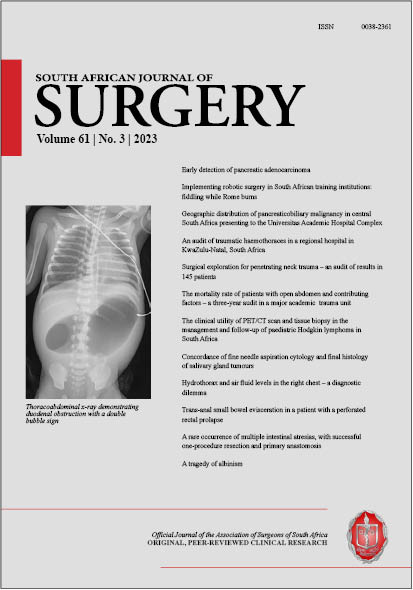
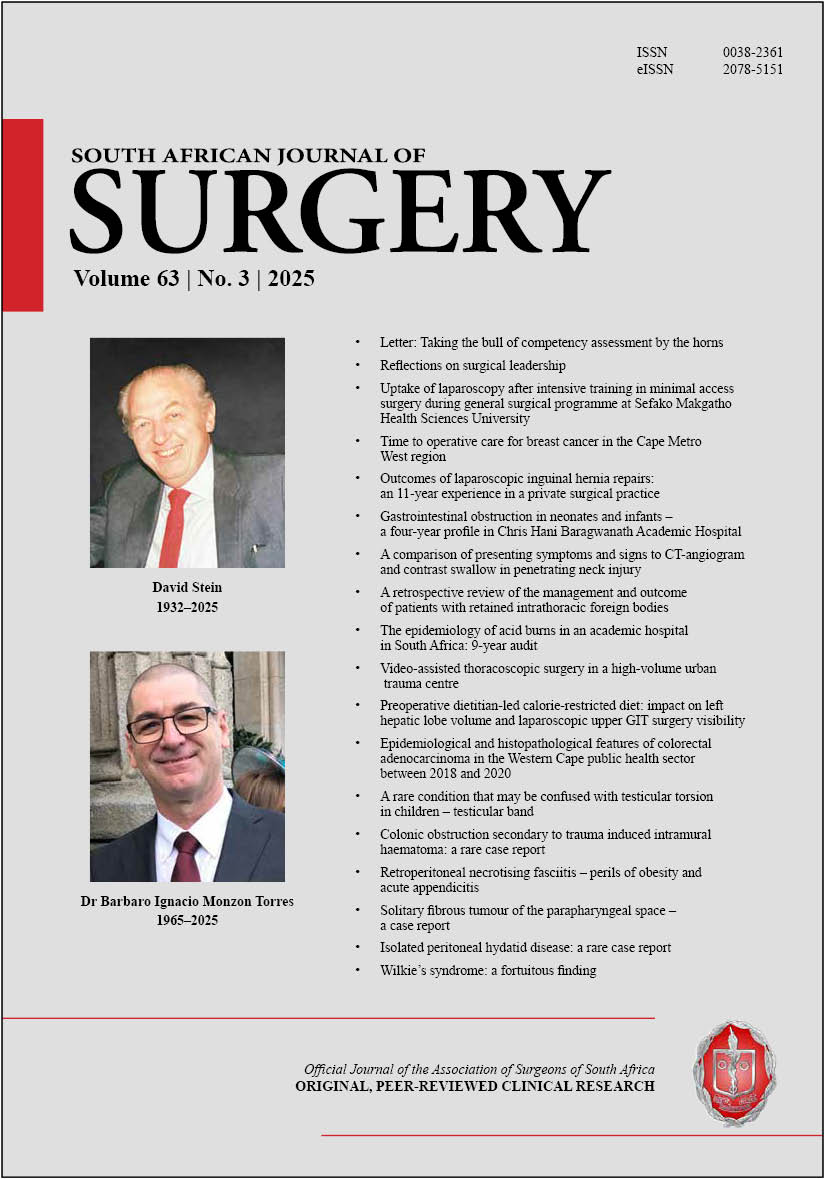
Uptake of laparoscopy after intensive training in minimal access surgery during general surgical programme at Sefako Makgatho Health Sciences University
DOI:
https://doi.org/10.36303/SAJS.00384Keywords:
laparoscopy, minimal access surgery, surgical training, uptake, barriers to laparoscopic surgeryAbstract
Background: The proven advantages of minimal access surgery (MAS), such as laparoscopy, are globally recognised. However, its adoption is variable in all countries irrespective of income level. One of the commonly cited barriers is lack of training. This study assesses the uptake of laparoscopy following intensive MAS training in the general surgical program at Sefako Makgatho Health Sciences University (SMU).
Methods: Surveying general surgeons trained at SMU between 2012 and 2018, who had completed their training at SMU and worked elsewhere thereafter. Questionnaires, distributed post-consent, were analysed descriptively.
Results: Among 22 participants, a 100% response rate was achieved. Prior to training, 86.4% were unable to perform laparoscopic appendectomy; 81.8%, laparoscopic cholecystectomy; 94.5%, laparoscopic bowel repair; and 100%, laparoscopic diaphragmatic injury repair. Post-training, participants judged themselves proficient in all these procedures. Participants are currently performing 53% of cases laparoscopically vs 47% via an open technique, with 35% opting for open surgery despite laparoscopic feasibility. The main barriers to using laparoscopic techniques were medical aid denial (59.1%) and lack of equipment (50%).
Conclusions: Intensive MAS training led to widespread laparoscopic adoption among SMU-trained general surgeons in South Africa. Key obstacles to a laparoscopic approach were medical aid refusal in the private sector and equipment scarcity in the public sector.
Downloads
Published
Issue
Section
License
Copyright (c) 2025 Author/s

This work is licensed under a Creative Commons Attribution-NonCommercial 4.0 International License.