
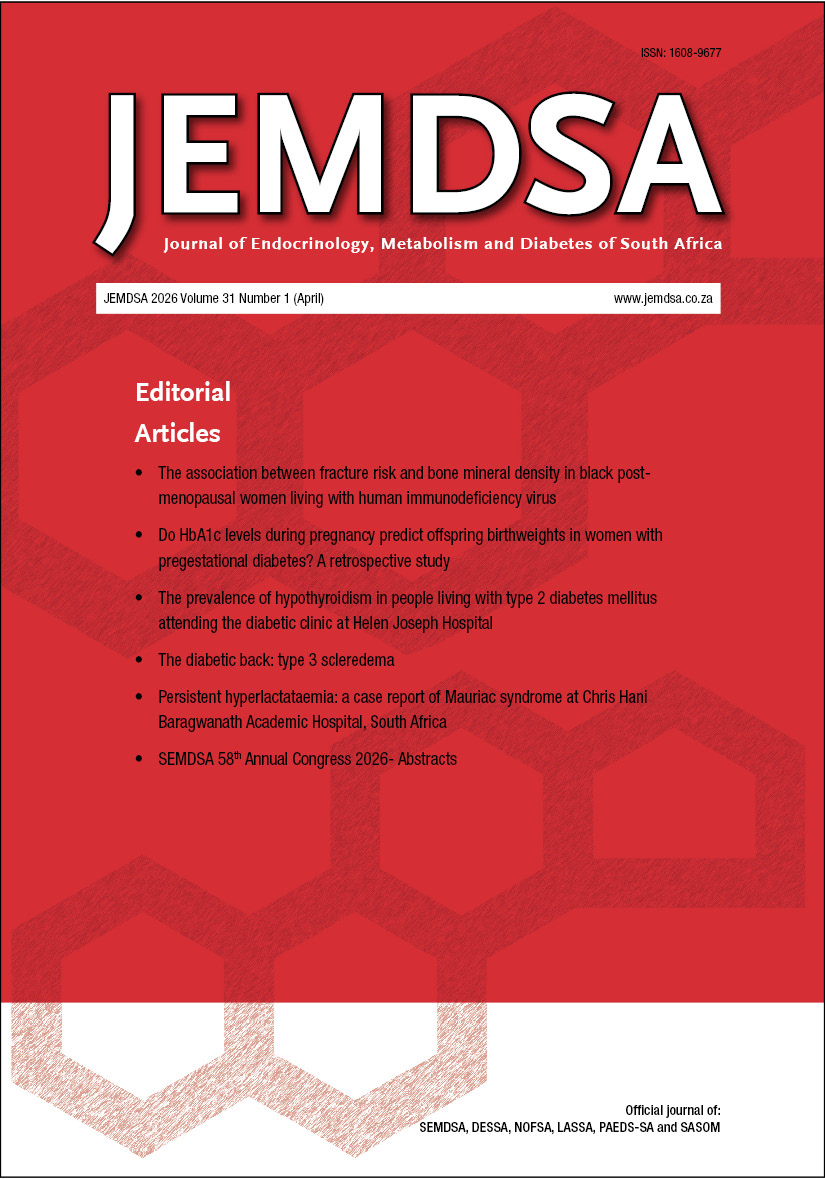
The association between fracture risk and bone mineral density in black postmenopausal women living with human immunodeficiency virus
DOI:
https://doi.org/10.1080/16089677.2025.2574154Keywords:
Africa, bone mineral density, fracture risk, HIV, osteoporosis, postmenopausalAbstract
Background: South African urban postmenopausal women have an increased risk for the development of low bone mineral density (BMD) and consequently osteoporosis. Osteoporosis and fractures are also a concern in people living with HIV (PLHIV).
Objectives: This study aimed to determine the 10-year fracture risk probability (major osteoporotic and hip) using the Fracture Risk Assessment Tool (FRAX®) and the association with BMD in Black postmenopausal women living with HIV on highly active antiretroviral therapy (HAART).
Methods: This study is a cross-sectional analysis that forms part of a prospective cohort study in South Africa. Baseline data from 120 Black postmenopausal women living with HIV were used. BMD was measured by dual X-ray absorptiometry (DXA) at the spine, left femoral neck of the hip, total hip, and total body. The fracture risk was determined using a validated online fracture risk instrument for South African populations. Multivariate linear regression models were applied to assess the associations of 10-year risk of major osteoporotic fracture or hip fracture, respectively, with site-specific BMDs, adjusting for calcium intake, serum vitamin D, duration of HIV infection, and physical activity.
Results: The median 10-year risk of major osteoporotic and hip fracture (1.3%, 95% CI 1.0, 2.1%, and 0.2%, 95% CI 0.1, 0.4%) was low. Risk of major osteoporotic fracture and hip fracture was negatively associated with site-specific BMDs (p < 0.05). Duration of diagnosed HIV infection showed a trend for an association with spine BMD (p = 0.058).
Conclusions: In settings with no access to DXA, fracture risk calculated using FRAX® will be a useful indicator of site-specific BMD among Black postmenopausal women living with HIV. Although the FRAX tool is not validated in individuals living with HIV, both FRAX fracture risk estimates and DXA-derived BMD assessments independently predicted a similarly low probability of fracture.
Downloads
Published
Issue
Section
License
Copyright (c) 2026 Author/s

This work is licensed under a Creative Commons Attribution-NonCommercial 4.0 International License.